Managing a growing school transport fleet is not simply about adding more buses.
As student numbers increase, school transport operators have to manage more routes, pickup points, drivers, schedules, and daily trips. What may work smoothly for 10 or 20 buses can become difficult when the fleet reaches 50, 100, or more vehicles.
This is where route optimization becomes increasingly important.
Instead of continuously adding buses to handle operational growth, transport operators can use technology to make better use of the vehicles they already have. With GPS Tracking Software, Live School Bus Tracking, and modern School Transport Software, operators can gain better visibility into routes and identify opportunities to improve fleet utilization.
The goal is not simply to find the shortest route. It is to create school transport operations that are more organized, predictable, and scalable.
Why Growing School Fleets Need Better Route Planning
School transport routes are more complicated than ordinary point-to-point transportation.
A single school bus may have multiple pickup points, different student locations, fixed school timings, and specific route restrictions. Traffic conditions can also change throughout the day.
When routes are planned manually, transport teams may depend on spreadsheets, maps, phone calls, and individual experience.
This can create several operational challenges:
- Buses covering unnecessarily long routes
- Overlapping routes between vehicles
- Uneven distribution of students
- Longer travel times
- Higher fuel consumption
- Underutilized buses
- Difficulty managing route changes
- More pressure on transport coordinators
As the fleet grows, these small inefficiencies can become significant operational problems.
Route optimization helps operators analyze these factors and build more practical routes based on actual transportation requirements.
Route Optimization Is More Than Finding the Shortest Route
A common misconception is that route optimization simply means finding the shortest distance between two locations.
School transportation requires a broader approach.
An optimized route may need to consider:
- Student pickup and drop-off locations
- Bus capacity
- Number of students
- Pickup time windows
- School start and end times
- Existing routes
- Traffic conditions
- Driver availability
- Distance and travel time
- Route overlaps
- Operational constraints
The objective is to balance multiple requirements instead of focusing on distance alone.
For school transport operators, this can mean better utilization of existing buses without compromising the practical requirements of daily student transportation.
How Route Optimization Helps Manage More Buses
As operators add vehicles, manually coordinating every route becomes increasingly difficult.
Logiciel de transport scolaire can provide a centralized environment for planning and managing routes. Instead of maintaining separate information across spreadsheets and documents, transport teams can work with structured route and fleet data.
This makes it easier to understand which buses are assigned to which routes and where operational changes may be required.
For example, if two buses are operating on routes that partially overlap, route data may help the operator identify whether the students and stops can be redistributed more efficiently.
Similarly, if one bus is heavily loaded while another is underutilized, operators can review the route structure and explore better allocation.
This does not necessarily mean reducing the fleet. It means using the existing fleet more effectively.
Live School Bus Tracking Makes Route Optimization More Practical
Planning a route is only one part of efficient transportation management.
Operators also need to understand what is happening during the actual trip.
This is where Live School Bus Tracking becomes valuable.
Real-time location data can help transport teams monitor whether buses are following planned routes and identify unexpected delays or deviations.
For example, a planned route may look efficient on paper, but real-world traffic conditions can affect travel time. By monitoring live vehicle movement, operators can better understand how routes perform in actual conditions.
Historical tracking data can also provide useful insights into recurring delays, frequently congested areas, and route performance.
This creates a continuous cycle:
Plan → Monitor → Analyze → Improve
Instead of planning routes once and leaving them unchanged, operators can continuously improve transportation operations based on actual data.
Better Fleet Utilization Without Immediately Adding Buses
When student numbers increase, the first solution may appear to be purchasing additional buses.
But before expanding the fleet, operators can examine whether their current vehicles are being fully utilized.
Route optimization can help answer questions such as:
- Are some buses operating below capacity?
- Are multiple buses covering similar areas?
- Can students be distributed more effectively?
- Are some routes significantly longer than others?
- Can pickup points be reorganized?
- Are buses spending too much time waiting or traveling empty?
The answers can help operators identify areas where existing resources may be used more efficiently.
This is particularly important for operators working with tight transportation budgets.
Reducing Unnecessary Travel
Longer routes do not only affect student travel time.
They can also increase fuel consumption, vehicle usage, driver hours, and maintenance requirements.
For operators managing a large fleet, unnecessary kilometers can accumulate quickly.
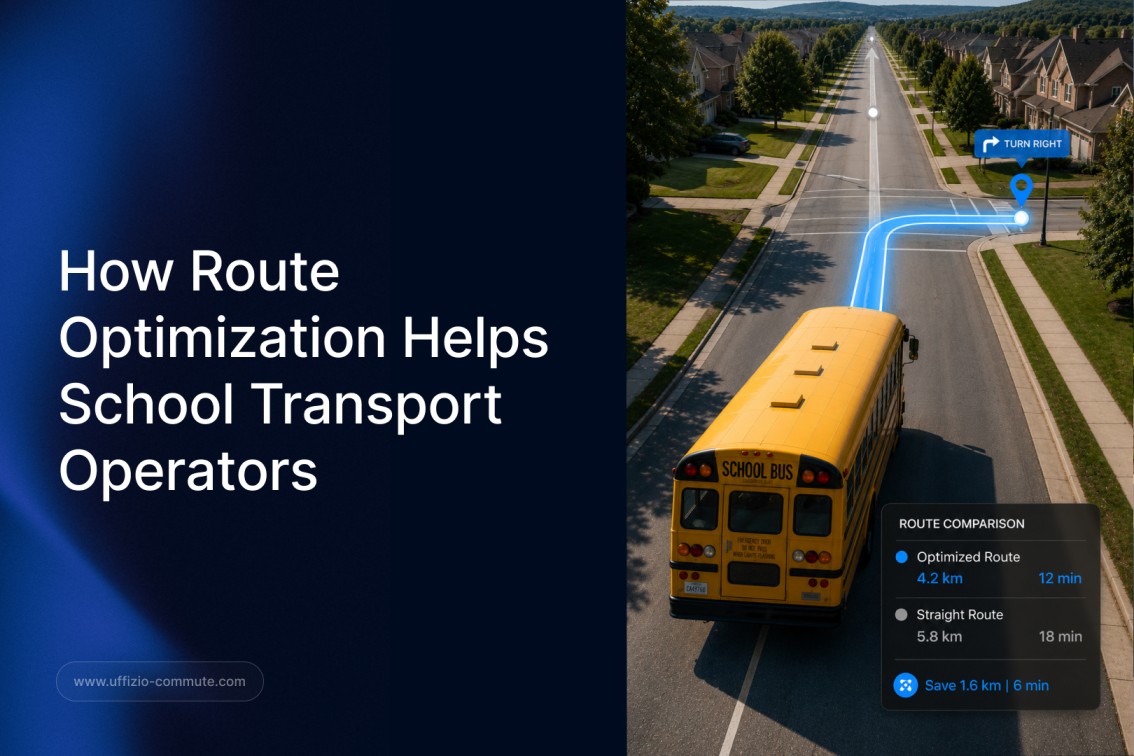
Route optimization helps transportation teams design more efficient journeys by considering student locations, stops, vehicle capacity, and operational requirements.
Combined with GPS Tracking Software, operators can compare planned routes with actual vehicle movement and identify where unnecessary travel may be occurring.
Over time, this data can support better route planning decisions.
Supporting Better Driver and Trip Management
Route optimization can also make driver and trip coordination easier.
When drivers receive clear route assignments and transport teams have better visibility into trip schedules, there is less room for confusion during daily operations.
A centralized School Transport Software platform can help connect routes with buses, drivers, and scheduled trips.
This becomes especially useful when operators manage multiple schools or large fleets across different areas.
Instead of relying entirely on manual communication, transport teams can work from a common operational system.
What Happens When a Route Changes?
School transportation rarely follows the same pattern every day.
A student may change their pickup location. A road may be temporarily closed. A new student may join a route. A bus may become unavailable.
These situations require quick operational decisions.
A flexible School Transport Software solution can help transport teams manage route changes more systematically.
Combined with Live School Bus Tracking, operators can also monitor how changes affect actual trips.
This creates greater operational flexibility without requiring the entire transportation plan to be rebuilt manually.
The APAC and Africa Perspective
School transport operators across APAC and Africa operate in diverse transportation environments.
Some manage transportation for individual schools, while others operate services across multiple institutions, campuses, or locations.
In these environments, fleet growth can bring additional complexity. Different road conditions, traffic patterns, student locations, and operational structures can make manual route planning increasingly difficult.
Technology can help operators create a more data-driven approach to transportation management.
GPS Tracking Software provides vehicle visibility. Live School Bus Tracking provides real-time trip monitoring. School Transport Software brings these capabilities together with route, trip, and operational management.
For growing operators, this connected approach can provide a foundation for scaling transportation services more systematically.
What Operators Should Look for in Route Optimization Software
Before choosing a solution, school transport operators should look beyond basic map-based routing.
Important capabilities can include:
- Route planning and optimization
- Real-time vehicle tracking
- Live School Bus Tracking
- Bus and driver assignment
- Student and stop management
- Route monitoring
- Gestion des voyages
- Alerts and notifications
- Historical trip data
- Reports and analytics
- Scalable fleet management
The right combination depends on the size and requirements of each operation.
The important point is that route optimization should work as part of the wider transport management process rather than as an isolated feature.
Route Optimization Can Become a Growth Strategy
For school transport operators, growth does not always have to mean adding more vehicles.
Sometimes, the opportunity is to make the existing fleet work smarter.
Better route planning can help operators understand how buses are being used, where routes can be improved, and how transportation resources can be allocated more effectively.
When combined with GPS Tracking Software and Live School Bus Tracking, route optimization can turn daily vehicle data into useful operational insights.
This gives operators a stronger foundation for managing increasing numbers of students, routes, and buses.

Conclusion
Managing more school buses efficiently requires more than simply increasing fleet size.
As transportation operations grow, manual route planning can become difficult to maintain. Overlapping routes, unnecessary travel, uneven bus utilization, and limited visibility can increase operational pressure.
Route optimization provides a way to approach these challenges more systematically.
With School Transport Software, operators can connect route planning with fleet and trip management. With GPS Tracking Software, they can gain visibility into vehicle movement. And with Live School Bus Tracking, they can monitor actual trips and use real-world data to improve future planning.
For school transport operators across APAC and Africa, this combination can support a more scalable approach to fleet management.